

For Singapore company incorporation, corporate shareholder documents often cause more delay than the local forms. It is also worth checking how much providers charge to register a Singapore Pte Ltd so you can budget the engagement early. The filing usually stalls on the foreign parent's own paperwork. The corporate shareholder documents proving existence, current officers, signing authority and ownership are what a filing agent and a bank probe first.
Singapore's regulator, the Accounting and Corporate Regulatory Authority (ACRA), does not normally demand the parent's certified document chain as part of the incorporation filing. But the corporate service provider lodging the transaction must verify the client and its beneficial owners before anything is filed. The bank repeats the exercise afterwards.
Our team often sees predictable causes of delay. These include stale registry extracts, resolutions without a named signatory, and ownership charts ending at an intermediary. Each is fixable if it is identified early.
This guide sets out the document pack a foreign parent company should prepare. It explains who requires each item, what ACRA needs for the Singapore company itself, and how difficult structures are handled. In this blog, we discuss the evidence that turns a foreign parent into a compliant shareholder of a Singapore Pte. Ltd.
Table of Contents
What Documents Does a Corporate Shareholder Need for a Singapore Subsidiary?
Four things must be evidenced before anything is filed:
- The parent exists.
- Its officers are current.
- The signer is authorised.
- Its ownership can be traced to natural persons.
Every foreign corporate shareholder, wherever it is incorporated, is tested against the same four questions. Does the company legally exist? Who are its current directors? Has a competent body approved the Singapore investment and named someone to sign? And who ultimately owns or controls it?
A practical starting point is the parent's exact legal name, registration number, legal form, incorporation jurisdiction and registered address. Treat that as an indicative intake starting point rather than a statutory ACRA document list, because the full pack depends on the parent's jurisdiction and structure.
The pack described below is a practitioner's document map, not an ACRA requirement. The regulator sets out what it needs for the Singapore company itself. Beyond the shareholder documents covered here, Singapore company registration for foreigners also brings local director rules, which require at least one locally resident director. The evidence of the parent's existence, officers, authority and ownership is what your corporate services provider and the bank will examine.
What Goes Into a Practical Corporate Shareholder Document Pack?
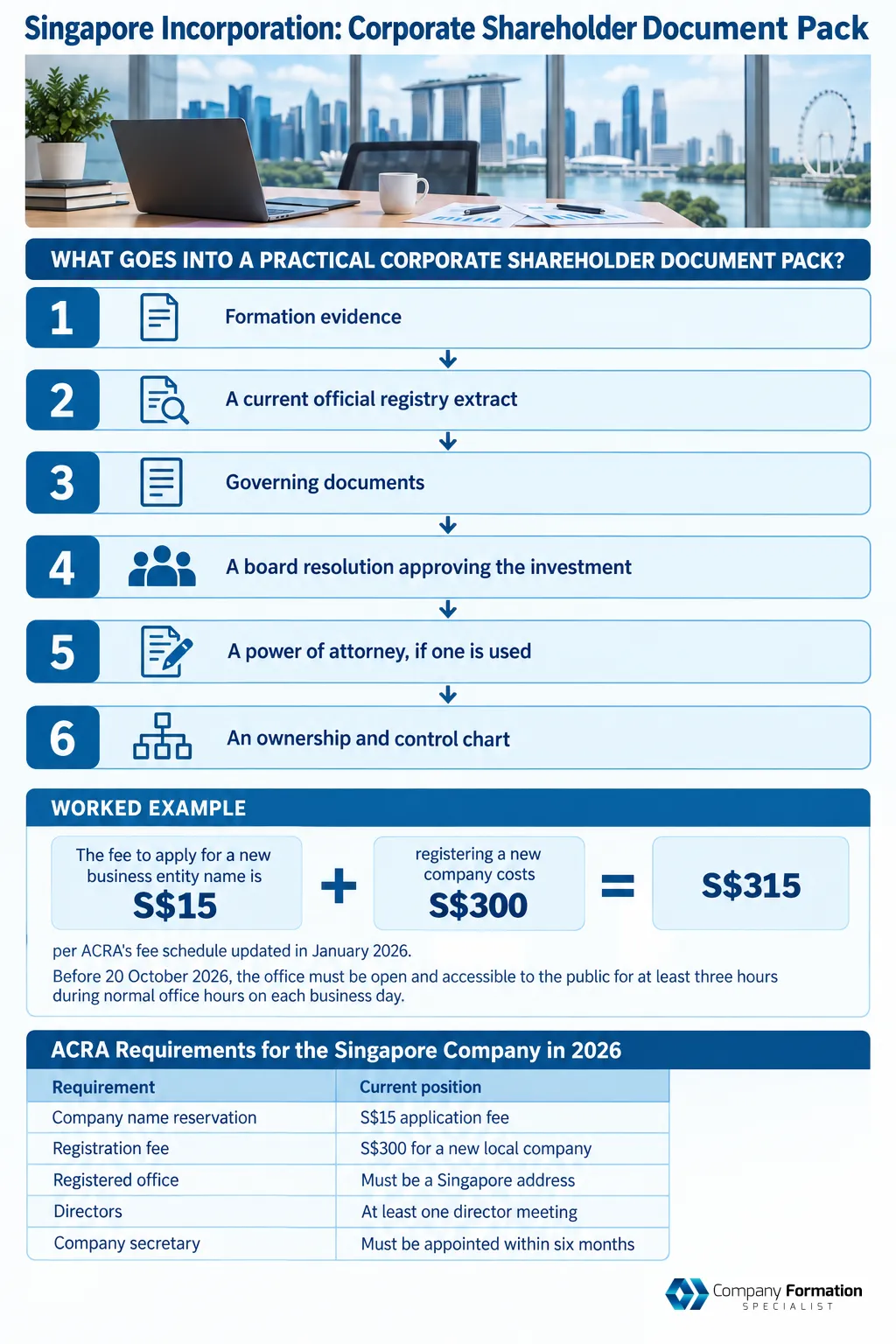
A practical pack often includes formation evidence, a current registry extract, governing documents, a board resolution, signatory identification and an ownership chart.
Assembling the Singapore subsidiary incorporation documents early prevents avoidable delays later. A corporate service provider may request some or all of the following, depending on the parent's home country and structure. The sufficiency of any single item depends on the parent jurisdiction, the document's content and the relevant foreign law.
1. Formation evidence
A certificate of incorporation, or the equivalent trade-register extract used in many civil-law countries, establishes the parent's legal existence. The form of this evidence varies by jurisdiction, so an equivalent official record is usually acceptable.
2. A current official registry extract
A registry extract or company profile helps confirm active status, the registered address and the current directors and officers. In practice, a stale extract is one of the most common reasons a pack is sent back for refreshing.
3. Governing documents
The parent's constitution, articles or equivalent sets out its capacity and execution rules. This is what an experienced preparer reads first to confirm who can validly bind the company.
4. A board resolution approving the investment
The resolution should approve formation of the subsidiary or the share subscription, the number and class of shares, and the authorised signatory. This is prudent authority evidence rather than a universal ACRA-prescribed format, and foreign-law execution rules differ.
5. A power of attorney, if one is used
Where an attorney signs, the power should be checked for scope, validity and execution formalities. Notarisation, apostille or legalisation can depend on the governing law, the document type and the recipient's requirements.
6. An ownership and control chart
The chart should trace the corporate shareholder to the natural persons who ultimately own or control it, supported by extracts or registers at each material layer. Voting, appointment and contractual control matter too, not just shareholdings.
Core Documents for a Foreign Corporate Shareholder
| Document | What it helps establish | Notes |
|---|---|---|
| Certificate of incorporation or equivalent | Legal existence of the parent | Civil-law jurisdictions may issue trade-register extracts instead |
| Current official registry extract | Active status, registered address, current directors | Freshness is a provider or bank standard, not an ACRA rule |
| Constitution, articles or equivalent | Corporate capacity and execution rules | Sufficiency depends on the parent's jurisdiction and governing law |
| Registers of directors and members | Officers and members where the extract omits them | Often needed for multi-layer groups |
| Board resolution | Approval of the investment and the authorised signatory | Should identify the subsidiary, the shares and the subscription amount |
| Power of attorney | Delegated authority to sign | Check scope, validity and execution formalities |
| Ownership chart | Natural persons who ultimately own or control the parent | Supported by documents at each material layer |
| Signatory identification | Identity and address evidence for each signer | Passport and residential-address evidence are typically requested |
Who Requires Each Document: ACRA, Your Service Provider or the Bank?
ACRA, the corporate services provider and the bank each demand different things, and the three demands should be planned separately.
ACRA does not ordinarily require the entire certified corporate chain as attachments to an incorporation filing. What the regulator needs is accurate information about the new company and its position holders.
A registered filing agent faces a different obligation. Under ACRA's rules for corporate service providers, customer due diligence must be completed before corporate services are provided and before any transaction is lodged. That is why the parent's registry extract, authority documents and ownership evidence must be in hand before filing, even though ACRA never sees most of them.
The bank runs a third, separate exercise after registration. ACRA's post-registration guidance notes that banks typically ask for signatory information, a board decision, certified company documents and identity checks. Individual banks set their own onboarding requirements and may request newer or bank-form documents even after incorporation is complete.
Tax forms, account mandates, contracts, invoices and expected-transaction profiles are mainly bank-onboarding material. They can be prepared in parallel rather than treated as incorporation attachments. A provider may still ask about business purpose or funding for its own risk assessment.
Who Requires Each Document and When
| Document | ACRA filing | Provider due diligence | Bank onboarding |
|---|---|---|---|
| Parent particulars: name, number, jurisdiction, legal form, address | Required as incorporation data | Verified before filing | Verified again |
| Certificate of incorporation and registry extract | Not routinely an attachment | Required before filing | Commonly requested, often refreshed |
| Parent's constitution or articles | Not routinely an attachment | Capacity and execution check | Sometimes requested |
| Board resolution approving the investment | Not an ACRA attachment | Authority evidence before execution | Commonly required |
| Power of attorney | Not an ACRA attachment | Reviewed before the attorney signs | Original or certified copy may be required |
| Ownership chart and supporting evidence | Not an attachment; feeds controller records | Required for AML checks | The bank repeats its own assessment |
| Passports and address evidence for controllers | Not an attachment | Required for identified persons | Bank KYC forms apply |
| Tax forms, mandates, contracts, expected-transaction profile | Not needed by ACRA | May support the risk assessment | Core onboarding material, prepared in parallel |
Who Can Validly Sign for the Foreign Parent Company?
A current director, a person expressly authorised by board resolution, or an attorney under a valid power of attorney may sign. Each needs supporting evidence before the documents are accepted for filing.
The corporate shareholder normally signs the subscriber portion of the Singapore company's constitution and any share-subscription or incorporation instructions. ACRA requires a constitution to be submitted when applying to incorporate, and the signed copy must be signed by all subscribers.
ACRA does not prescribe one universal signature method for a foreign company. Who may bind the corporate subscriber depends on the parent's governing law, its constitution and the authority evidence available.
An email from an employee is not corporate authority. Where authority is genuinely ambiguous, a legal opinion from counsel in the parent's jurisdiction is the safer course than guessing from a job title.
1. A director on the registry record
A director can be accepted once reliable registry or incumbency evidence confirms the person is current. The parent's governing law and constitution must also allow that mode of execution.
2. A person authorised by board resolution
Another officer or employee is acceptable where a board resolution expressly authorises that person. The resolution should name the signatory and describe the documents they may execute.
3. An attorney under a power of attorney
An attorney is acceptable where the power covers forming and subscribing for shares in a foreign subsidiary and remains in force. The full power, its execution formalities and any notarisation should be inspected before reliance.
What Does ACRA Require on the Singapore Side in 2026?
Name reservation, a S$300 registration fee, a Singapore registered office, at least one locally resident director and full position-holder details.
The parent's document pack is separate from ACRA's own requirements for the new company. According to ACRA's Bizfile registration guide, you must first reserve a name; the reserving person may register directly if appointed as a director or secretary, or engage a corporate service provider to register the company.
The fee to apply for a new business entity name is S$15, and registering a new company costs S$300, per ACRA's fee schedule updated in January 2026. Most registrations are approved soon after payment, though complex applications can take longer.
The company must have a registered office in Singapore from incorporation, and it does not have to be where the business actually operates. Before 20 October 2026, the office must be open and accessible to the public for at least three hours during normal office hours on each business day. From 20 October 2026, that minimum public-access requirement is removed.
At least one director who meets local-residency rules must be appointed during registration. Every position holder must provide personal details, a residential address and a contact address, which is displayed in ACRA's public records.
A company secretary must be appointed within six months of registration if one is not appointed at incorporation. Where a corporate service provider files the transaction, the usual endorsement step for other position holders is not required; otherwise endorsements are due within 60 days.
For companies incorporated from 16 June 2025, initial registrable-controller information for the central register is filed on the same day as registration, unless the company is exempt. Later updates are due within two business days after the company's private register is updated. Controller analysis should follow the statutory definitions and current ACRA guidance, not ownership percentages alone.
ACRA Requirements for the Singapore Company in 2026
| Requirement | Current position |
|---|---|
| Company name reservation | S$15 application fee; the reserving person may register directly, or a corporate service provider may register on the applicant's behalf |
| Registration fee | S$300 for a new local company; most filings are approved soon after payment |
| Registered office | Must be a Singapore address from incorporation; minimum public-access hours are being removed from 20 October 2026 |
| Directors | At least one director meeting local-residency rules must be appointed at registration |
| Company secretary | Must be appointed within six months of registration if not appointed at incorporation |
| Constitution | Must be submitted at incorporation and signed by all subscribers |
| Registrable controllers | Companies incorporated from 16 June 2025 file initial central-register information when registering, unless exempt |
| Endorsements | Other position holders must endorse within 60 days unless a filing agent lodged the transaction |
How Are Ownership Gaps, Foreign Languages and Complex Groups Handled?
By escalating: tracing each layer with documents, translating or authenticating where evidence is unreliable, and matching the pack to the parent's structure.
Our team commonly sees recurring document issues:
- Stale registry extracts.
- Board resolutions that do not clearly identify the subsidiary, shares or signatory.
- Ownership chains that stop at an intermediate holding company.
- Non-English records without an acceptable translation.
None of these are fatal, but each adds time. Where evidence is unreliable, difficult to verify or unclear, the response may include certified translation, certification, authentication or foreign-law advice. This depends on the jurisdiction and risk. Certified translation and notarisation are not automatic ACRA incorporation requirements — they depend on who is relying on the document and why.
Document freshness is another point to clarify early. Any expectation that a registry extract be recent is the service provider's working standard or the bank's requirement, not a universal ACRA rule.
Public regulator or exchange records may corroborate a listed or regulated parent's status, officers and ownership disclosures. They do not by themselves establish authority for the specific Singapore share subscription.
Sector licences are a separate layer again. A subsidiary operating a licensed trade needs regulator-specific documents alongside the shareholder pack. This can apply to businesses such as freight forwarding, elder care services or hair salons in Singapore.
Where the parent's capacity or signing authority is unclear, obtain jurisdiction-specific legal advice. You can also contact us for a checklist tailored to the parent's home country.
Extra Evidence by Parent-Company Type
| Parent type | Additional documents often requested |
|---|---|
| Simple private company | Core pack above, with registers where the public extract omits officers |
| Multi-layer group | Registry or incumbency evidence at each intermediate layer, up to natural-person controllers |
| Regulated entity | Regulator records corroborating status, officers and licences |
| Listed company | Exchange disclosures and the latest ownership filings |
| Trust, foundation or partnership layer | Governing and control documents for the structure itself |
Conclusion
Company Formation Specialist helps foreign parent companies gather the right evidence before anything is filed. We start with the parent's identifiers and check its governing documents and board authority. We then trace ownership to the natural persons behind it. This helps the ACRA filing, the due-diligence file and the bank pack line up.
For the Singapore side, we handle name reservation, constitution preparation and the Bizfile filing. We can also provide a local registered office, a nominee local director and company secretary support. Whether your parent is a simple private company or a multi-layer group, the approach is mapped to its structure.
Get the documents for your Singapore subsidiary right the first time. Talk to our team through our contact page and we will guide you through the pack your parent needs.
Ready to Register Your Singapore Subsidiary?
Let our team review the parent company's documents and manage the incorporation from name reservation to completion.
Frequently Asked Questions
Not as a rule. ACRA needs accurate information about the new company and its position holders. However, the corporate service provider lodging the filing must verify the client, its beneficial owners and the signer's authority before filing, so the parent's pack must still be in hand.
It should approve the formation of the Singapore subsidiary or the share subscription, the number and class of shares, the subscription amount and the person authorised to sign. This is prudent authority evidence rather than a format ACRA prescribes, and execution rules under the parent's governing law may differ.
There is no universal ACRA freshness rule for incorporation. Any expectation that an extract be recent is set by your corporate services provider as a working standard, or by the bank at onboarding, which may ask for refreshed documents after incorporation.
Yes, but non-English or hard-to-verify records may require translation, certification, authentication or foreign-law advice depending on the jurisdiction and risk. Certified translation and notarisation are not automatic ACRA incorporation requirements.
No. The corporate shareholder typically signs the constitution's subscriber portion and subscription instructions remotely, and the filing agent lodges the electronic transaction through Bizfile. What matters is verifiable authority to sign, not physical presence.

Company Formation Specialist
Author
Company Formation Specialist is a Singapore corporate services provider that guides local and foreign entrepreneurs through registering and setting up a company in Singapore.