

An overseas director cannot use a Singapore company's office as a personal contact address while living abroad. The Accounting and Corporate Regulatory Authority (ACRA) requires your contact address to be in the same country as your home. This applies if you live in Australia or the UK, for example.
Singapore company registration collects several distinct addresses: the company's registered office, your residential address, your personal contact address, and any operational mail arrangements. In our practice, mixing these up is the most predictable address mistake made by directors and shareholders based overseas.
Getting the personal-address fields right matters beyond the filing itself. Your contact address is public, while your residential address is generally protected, subject to exceptions. Banks apply separate due-diligence rules.
This article explains what ACRA means by a contact address and when a registered office can double as one. It also covers residential-address privacy and checks to make before filing. In this blog, we discuss the practical address decisions every overseas director and shareholder faces when registering a Singapore company.
Table of Contents
What Does a Singapore Company Contact Address Actually Mean?
It is the personal address ACRA displays publicly for an individual officer or shareholder. It is a separate field from your residential address, though both fields can contain the same address.
When you register a local company through Bizfile, ACRA collects two personal addresses for each individual position holder. These include directors, secretaries and individual shareholders. The first is your usual residential address: your actual home, including the country. ACRA sends official letters to this address.
The second is your contact address. This is the address displayed in ACRA's public records, and it can be the same as your residential address. If you use your home as your contact address, that location becomes public in its contact-address capacity. That trade-off is worth understanding before you file.
The contact address must meet three conditions, according to ACRA's guide to registering a local company via Bizfile. It must be in the same country as your residential address. It must be a physical address where you can be physically found or contacted by post. An office or service provider's office may qualify if the conditions are met. Mail forwarding alone does not establish eligibility. It cannot be a P.O. Box address. There is no fee to register a contact address.
The company's own address is separate. The registered office is the company's Singapore address, where its records are kept and where they remain available for inspection on reasonable notice for at least two hours on each relevant day. These details are lodged during incorporation. ACRA's published service and transaction fees list S$15 for a name application and S$300 for registration.
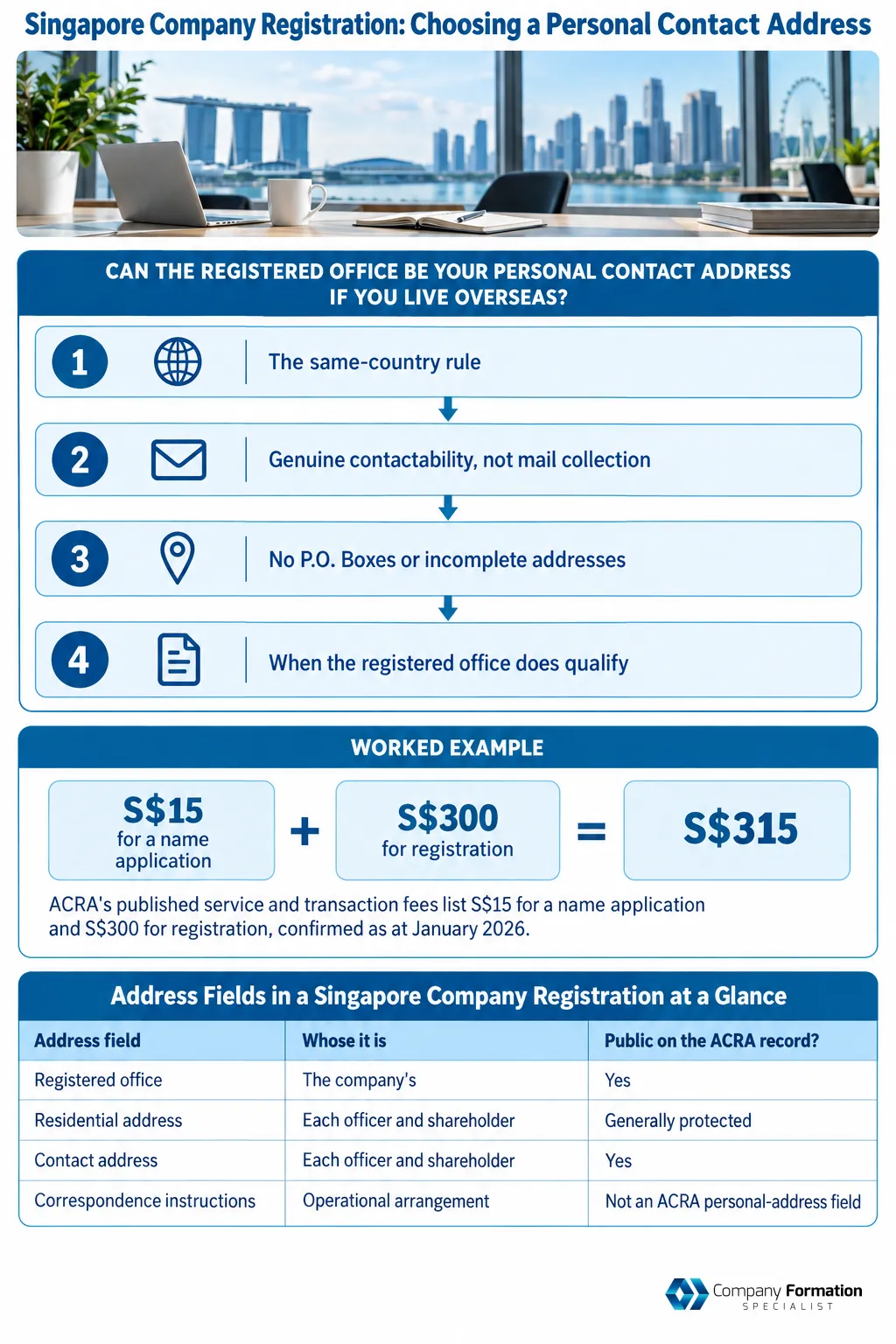
Address Fields in a Singapore Company Registration at a Glance
| Address field | Whose it is | Public on the ACRA record? | Key rule |
|---|---|---|---|
| Registered office | The company's | Yes | Must be a Singapore address that can receive communications and notices; no minimum opening hours since 20 October 2026 |
| Residential address | Each officer and shareholder | Generally protected | ACRA sends official letters to this address |
| Contact address | Each officer and shareholder | Yes | Same country as the residential address; no P.O. Box |
| Correspondence instructions | Operational arrangement | Not an ACRA personal-address field | Directs company mail; changes nothing on the filing |
Can the Registered Office Be Your Personal Contact Address if You Live Overseas?
No. ACRA requires the contact address to be in the same country as your residential address, and a Singapore office sits in a different country from your overseas home.
The question we ask first, when an overseas founder wants to use a Singapore office as their personal address, is simple: in which country do you actually live? The answer determines everything. A founder resident in Australia cannot select a Singapore contact address merely because their provider receives the company's mail there.
A purely hypothetical illustration shows how the pieces fit. Picture a UK-resident founder — call her Maya — who will be both shareholder and overseas director. She has a Manchester home (H), her accountant's staffed Manchester office (C), and a Singapore registered-office service (R). Maya initially wants R entered in every field, so no personal address appears anywhere on the record.
The filing cannot work that way. H is recorded as her residential address. R fails as her contact address because it sits outside the UK. C can qualify if the accountant permits its use and Maya can be physically found or contacted by post there. R remains what it should be: the company's registered office. A separate mail instruction can still direct company mail received at R to her preferred destination, but that instruction changes neither personal-address field.
An accountant's office is not automatically eligible just because it receives mail. The individual must satisfy ACRA's physical-location and contactability conditions, and the arrangement must genuinely work in practice. Note the limit of this answer: it addresses the ACRA filing question only. Whether a bank or another organisation accepts the office as a correspondence address is a separate matter.
1. The same-country rule
ACRA requires the contact address to be in the same country as the residential address. This single requirement is what disqualifies a Singapore registered office for a founder living overseas, no matter how convenient the address is.
2. Genuine contactability, not mail collection
The address must be a physical address where you can be physically found or contacted by post. This is one either/or requirement, not two separate tests: qualifying by physical location or by postal contact is enough. Consent to receive or forward mail alone does not make an address eligible, so we never treat a forwarding subscription as a substitute for a qualifying address.
3. No P.O. Boxes or incomplete addresses
A P.O. Box cannot serve as a contact address, and an overseas address missing its unit, street or postal details will not pass review. A usable physical address in your country of residence is needed instead.
4. When the registered office does qualify
A Singapore registered office can also serve as an individual's contact address where their residential address is also in Singapore and every contact-address condition is met. Residence alone is not sufficient; contactability and permission to use the address must both be confirmed.
Can the Registered Office Double as a Personal Contact Address?
| Your situation | Registered office as your contact address? | Why |
|---|---|---|
| You live in Singapore | Possibly, if all conditions are met | Same country; you must be contactable there and have permission to use it |
| You live overseas | No | ACRA requires the contact address to be in the same country as your home |
| You plan to relocate to Singapore | Only after you genuinely reside here | A visit or mail subscription does not change residence |
How Is Your Residential Address Protected on the ACRA Record?
Your residential address is supplied to ACRA but generally protected from ordinary public inspection, while your contact address is the address anyone can search and see.
For an individual director or shareholder, the contact address is the public-facing personal address on the ACRA record. The residential address is not a partially masked version displayed beside it. It is separately filed information, and access to it is restricted.
That protection is not absolute secrecy, and we never tell a client their home is private without checking what was actually entered. Three points matter. First, if you use your home as your contact address, that location is public in its contact-address capacity. Second, disclosures already made and records previously obtained are not undone by the contact-address regime. Third, ACRA can make a residential address public through the statutory process if the individual cannot be reached at the contact address. Specified persons may also request residential information through authorised channels.
Banking is a separate layer. Guidance from the Monetary Authority of Singapore (MAS) identifies the kinds of documents banks may use to verify a natural person's residential address for due-diligence purposes. A public contact address is not a substitute for that evidence. Equally, a bank does not gain unrestricted access to ACRA's protected residential data simply by being a bank; its requirements depend on the customer and the circumstances. These points reflect our reading of the rules as practitioners, and individual cases can turn on their own facts.
Public Access to an Overseas Director's Personal Addresses
| ACRA field | Ordinary public access | Exceptions to remember |
|---|---|---|
| Contact address | Fully visible in public records | Becomes public the moment it is filed |
| Residential address | Generally protected from public inspection | Public if used as the contact address; disclosable if you cannot be reached at the contact address; specified persons may request it through authorised channels |
What Checks Should You Make Before Filing a Personal Contact Address?
A short checklist helps identify address problems before filing and supports accurate records afterwards.
Our team checks for address problems such as a P.O. Box, an incomplete overseas address or a Singapore office offered by an overseas resident. The choice needs checking against the same-country and contactability requirements.
The personal-address rules apply whatever the business. They hold equally whether you are establishing a maid agency in Singapore, opening an adventure sports facility in Singapore, or building a jewelry business in Singapore. The sequence below is a general illustration of the checks an experienced practitioner works through — it is guidance, not a description of any particular filing system.
1. Start with your actual country of residence
Everything flows from where you genuinely live, not the address you prefer people to see. Confirm this first, because it fixes the country in which your contact address must be located.
2. Pick an address where you can genuinely be reached
Choose a physical address in your country of residence where you can be physically found or contacted by post. Agree how personally addressed letters reach you; mail forwarding alone is not enough.
3. Confirm you may use the address
Get the occupier's or provider's permission before filing. An office that receives mail for you is not automatically eligible unless you can genuinely be contacted there.
4. Use one contact address across all your positions
ACRA does not allow a person to give different contact addresses for the different entities in which they hold positions. Plan one address that works across your whole portfolio of roles.
5. Lodge changes with ACRA within 14 days
Local-company position-holder address changes generally need reporting within 14 days. Singapore citizens and permanent residents report residential-address changes to ICA, which updates ACRA. Contact-address changes use the applicable ACRA filing route. Correcting an inaccurate original filing is different from reporting a later change. A company secretary can help with the appropriate filing — see our guide to the key responsibilities of a company secretary in Singapore.
Does a Singapore Contact Address Satisfy the Resident-Director Requirement?
No. The local-residency requirement looks at where a director lives, not at which address appears in the filing.
ACRA requires every company to appoint at least one director who meets the local residency rules at incorporation. An overseas founder cannot satisfy that requirement by pointing to a Singapore contact address or the company's registered office. A visit, a Singapore company or a mail-forwarding arrangement does not change residence.
The founder can still be the sole shareholder while a separate qualifying person serves as the locally resident director. If you are unsure how these rules apply to your structure, contact us before filing. We can help you consider the positions and address fields.
Conclusion
The rules come down to three habits. Give ACRA your actual home as your residential address. Choose a contact address in the same country where you can genuinely be reached, remembering it will be public. Keep the registered office, personal addresses and mail instructions separate. Report later changes through the applicable route and observe the relevant deadline.
Getting your Singapore company contact address right at incorporation can reduce corrections and protect your home address where the rules allow. One qualifying contact address also keeps your position-holder records consistent. Where you live in Singapore and meet the conditions, the registered office may even serve double duty — but never while you reside overseas.
Company Formation Specialist guides overseas founders through name approval, incorporation filings, registered office arrangements, nominee local director needs and company secretary support. If you are registering a company in Singapore and want your address fields handled correctly the first time, we are glad to help.
Get Your Personal Address Filing Right Before You Submit
Tell us where you live and how you want to be contacted, and we will map every address field before anything is lodged with ACRA.
Frequently Asked Questions
No. ACRA requires a physical address where you can be physically found or contacted by post. Your office or a provider's office in your country of residence can work; a P.O. Box cannot.
Yes. Your home satisfies the same-country rule, but be aware it then appears in ACRA's public records in its contact-address capacity. The trade-off between convenience and privacy is yours to weigh.
No. ACRA does not allow an individual to provide different contact addresses for the different entities in which they hold positions, so plan one address that works across all your roles.
Yes, in specified circumstances. If you cannot be contacted at your contact address, ACRA can make your residential address public through the statutory process, and specified persons may request residential information through authorised channels.
No. Forwarding is an operational arrangement that changes nothing on the ACRA filing. It does not cure a country mismatch, and your bank may separately ask for residential-address evidence under its own due-diligence rules.

Company Formation Specialist
Author
Company Formation Specialist is a Singapore corporate services provider that guides local and foreign entrepreneurs through registering and setting up a company in Singapore.