

Can you really incorporate a Singapore company from overseas without ever boarding a plane? Yes, but identity verification still applies when you incorporate a Singapore company remotely. Depending on the circumstances, checks can include a live video call and supporting documents.
These checks are not paperwork for its own sake. Singapore's regime requires registered providers to conduct applicable due diligence. Limited exceptions permit identity verification to be deferred under conditions. Non-face-to-face dealings are treated as higher risk, so providers must apply specific measures to close that gap.
That is why you may be asked for more documents than a local founder, or for a short call with your original passport in hand. It is a normal part of the process, not a sign that anything is wrong with you or your business.
The rules matter because they decide what you prepare and when. This blog explains the regulations behind remote identity checks and a possible onboarding sequence. It also covers calls, clarifications and filing requirements at the Accounting and Corporate Regulatory Authority (ACRA).
Table of Contents
Why Does Identity Verification Come Before Singapore Company Incorporation?
Registered providers must conduct applicable due diligence, though identity verification may be deferred in limited circumstances.
ACRA oversees two layers of your incorporation: the registry filing itself, and the conduct of the registered provider making it. ACRA's guidelines for registered corporate service providers set out customer due diligence (CDD) obligations. These shape how a provider may take you on.
In practice, CDD is the formal name for the know-your-customer (KYC) checks most founders ask about. Applicable checks cover identifying and verifying the customer and authorised representatives, establishing beneficial ownership and control, understanding the purpose and intended nature of the relationship, and screening relevant people and entities. Recordkeeping and ongoing monitoring obligations sit alongside them.
Remote engagements add a layer. The guidelines treat non-face-to-face identification as carrying higher risk. Providers must use specific and adequate measures, including additional identity documents, data or information. The provider performs the checks, but you must supply the information it needs.
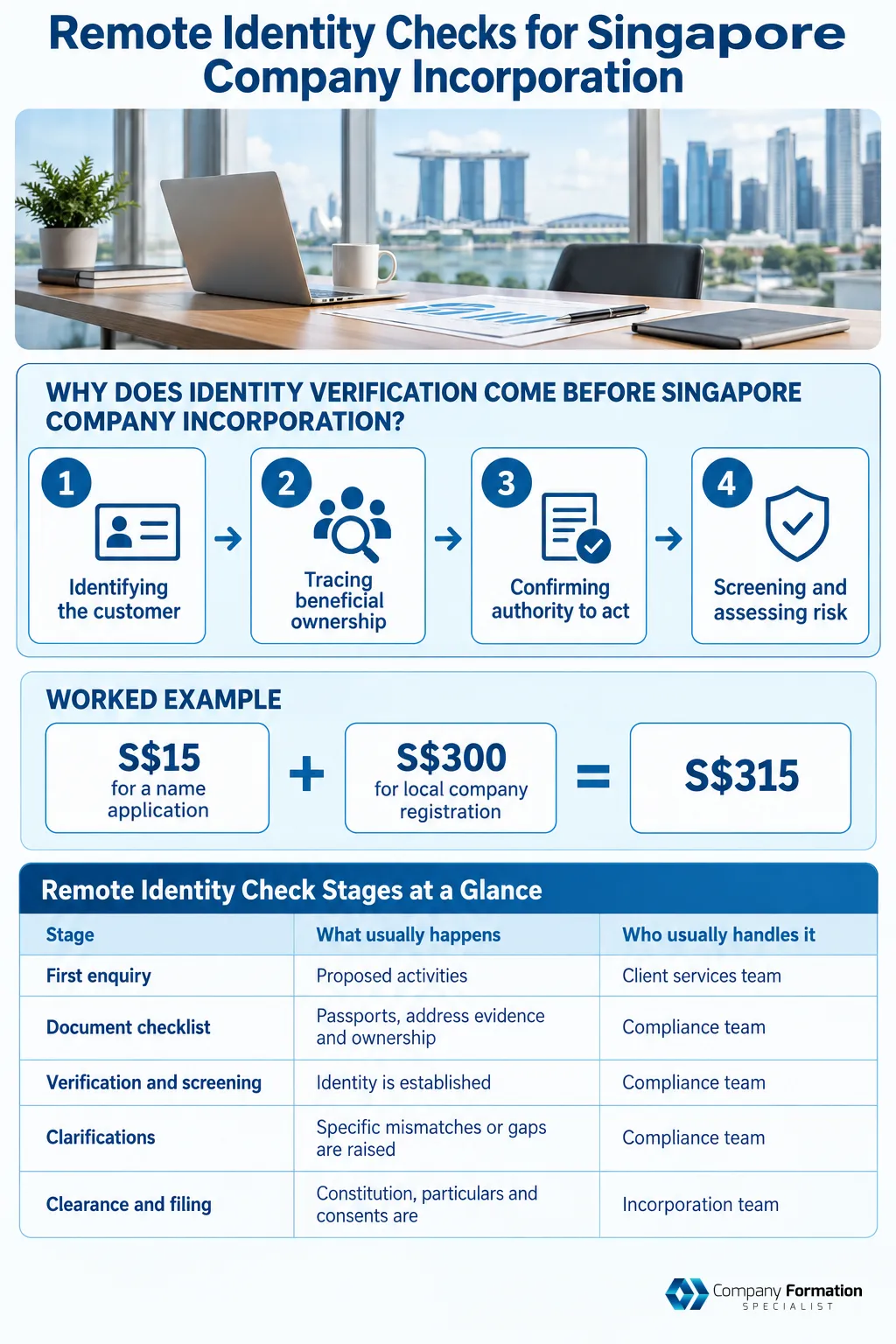
1. Identifying the customer
The provider identifies its customer and relevant authorised representatives. It may use passports for individuals and registry documents for companies.
2. Tracing beneficial ownership
The provider looks beyond the application form to identify relevant beneficial owners and control. The applicable inquiries depend on the circumstances, and ACRA's guidelines include exceptions for some customers.
3. Confirming authority to act
Checks confirm that the people giving instructions and signing documents are authorised to do so. Board resolutions, appointment letters or constitutional documents may be requested.
4. Screening and assessing risk
Relevant individuals and entities are screened, and the results feed a risk assessment. That rating decides how deep the remaining checks go, including whether enhanced due diligence applies.
How Does Remote Company Registration in Singapore Work Step by Step?
A possible sequence runs from enquiry and checks to document preparation and filing, but the provider's actual process may differ.
The sequence below is model-generated, not evidence of our firm's established practice. The team must confirm its sequence, staff responsibilities and authority to clear or file an engagement.
Separating compliance review from document preparation is a possible control. Our team's professional judgement is that a complete incorporation form should not be mistaken for completed identity checks.
Step 1: Enquiry and fact gathering
An early conversation collects your proposed business activities, ownership structure, directors, the countries involved and your intended presence in Singapore. This context frames the risk assessment that follows.
Step 2: The document checklist
A checklist may request passports, residential address evidence and ownership records. Ask the provider how to submit sensitive documents and how the information will be used and retained.
Step 3: Screening and risk assessment
Relevant people and entities are screened, and the provider assesses the money-laundering and other risks the engagement presents. A higher-risk rating means more questions, not automatic refusal.
Step 4: Verification, including the live call
Identity documents are checked against the people presenting them, and, where ACRA's requirement applies, a live video call is held. The next two sections cover who attends and what happens on it.
Step 5: Clearance, drafting and filing
Filing preparation includes reserving the company name. Our guide to the steps to register your business name in Singapore explains that step. The provider can then prepare the constitution and particulars and collect consents for Bizfile.
ACRA's fee schedule lists S$15 for a name application and S$300 for local company registration. Our guide on how much a provider charges to register a Singapore private limited company discusses budgeting. The firm's clearance and filing arrangements need confirmation.
Remote Identity Check Stages at a Glance
| Stage | What usually happens | Who usually handles it |
|---|---|---|
| First enquiry | Proposed activities, ownership structure, directors and intended Singapore presence are collected | Client services team |
| Document checklist | Passports, address evidence and ownership records are requested through a secure upload route | Compliance team |
| Verification and screening | Identity is established, ownership is traced, and relevant people and entities are screened | Compliance team |
| Clarifications | Specific mismatches or gaps are raised, with requests for evidence that resolves them | Compliance team |
| Clearance and filing | Constitution, particulars and consents are prepared, signed and lodged on Bizfile | Incorporation team |
Who Must Join the Video Call for Remote Company Registration in Singapore?
For an applicable remote incorporation, ACRA requires a live call with an eligible person. This can be a proposed non-nominee director, a qualifying member or that member's eligible representative.
ACRA's guidelines linked in the regulatory section explain when the requirement applies. For remote incorporation, a qualifying proposed member must hold at least half the voting rights. An eligible individual representative may attend for a member that is a legal person. The rule does not require every director, shareholder and beneficial owner to join a live call.
The guidelines also set out a representation exception. Where the customer is represented for the transaction by an advocate or solicitor, or by a public accountant, the position is treated differently. Note the limits, too: a certified document or a third-party verification platform cannot replace a call that the rules require, though certified evidence can supplement other checks.
For calls that are required, the provider must retain a screenshot and proper records. ACRA encourages recording the call as well but stops short of mandating it, so practices differ between providers. Check your provider's privacy notice rather than assuming either way.
Who ACRA's Live Video Call Requirement Covers
| Participant | Treatment under the requirement |
|---|---|
| Eligible proposed non-nominee director | Can take the live video call where the requirement applies |
| Proposed member holding at least half the voting rights | Can take the call as the individual with at least 50% voting power |
| Eligible individual representative of such a member | Steps in where the member is not itself an individual |
| Customer represented by an advocate, solicitor or public accountant | ACRA's guidelines set out this representation exception |
What Actually Happens During the Verification Call?
A reviewer may compare the person with identity evidence and ask about their role, authority, business and ownership. The exact checks vary.
The following are model-generated suggestions, not confirmed procedures at this firm. The team must confirm its questions and document checks. ACRA does not prescribe the same detailed method for every call.
A reviewer may ask you to show your original passport and compare it with your appearance and submitted evidence. They may also ask what the company will do, who owns it and how it will be funded. Answers can be checked against supporting documents; a live image alone is not conclusive authentication.
Our team's professional judgement is to prepare a valid passport and a clear picture of the ownership structure. Ask your provider what equipment and documents it requires.
What Happens If Your Documents Raise Questions?
A provider may ask for evidence to resolve a mismatch or missing ownership information. A clarification request is not itself a rejection.
These examples are hypothetical, not documented client engagements. Their questions and responses are model-generated suggestions, not confirmed firm procedures.
Suppose your passport shows your full legal name, but your address evidence uses initials and omits an apartment number. A provider could explain the mismatch and request reliable evidence that reconciles the details.
Alternatively, a corporate shareholder's ownership chart might stop at an intermediate holding company. A provider could request ownership records, an explanation of control and identification for relevant individuals. The applicable inquiries depend on the circumstances and any relevant exceptions.
Our team's professional judgement is to raise specific gaps rather than treat a clarification as a rejection. How long resolution takes depends on the information available.
1. Personal details that do not reconcile
Initials, shortened names or missing address details may need clarification. The provider may request reliable evidence that reconciles the particulars.
2. Ownership chains that stop mid-stream
A provider may request further records to understand ownership and control. The relevant inquiries depend on the circumstances and applicable exceptions.
3. Authority that is not yet evidenced
A representative acting for a corporate shareholder may need a board resolution or authorisation letter before their signature can be accepted.
Regulation Versus Provider Policy
| Layer | What it covers |
|---|---|
| Set by regulation or ACRA guidelines | Customer due diligence, beneficial-ownership tracing, screening, non-face-to-face measures, recordkeeping and the required live call |
| Set by the provider's own policy | Choice of video platform, routine call length, reminder schedule, and which supporting documents are requested beyond the applicable minimum |
What Do Enhanced Due Diligence Checks Involve for Higher-Risk Clients?
Higher-risk customers or structures can require enhanced due diligence. The measures depend on the risk and circumstances.
The measures depend on the risk and the circumstances. Where they apply, expect appropriate questions about the commercial reason for each ownership layer, evidence touching the source of funds and source of wealth, and corroboration of who really controls the company.
Two fair-minded points are worth knowing. A politically exposed person is not automatically prohibited from incorporating in Singapore. Equally, an unexplained offshore layer is not automatically evidence of wrongdoing, but neither is waved through because a passport looks genuine. Enhanced checks exist to resolve exactly these grey areas.
Common Clarification Triggers and Typical Responses
| Trigger | Typical response |
|---|---|
| Name or address details that do not reconcile | One consolidated request for replacement evidence, such as a bank statement showing the full residential address |
| An ownership chain that stops at a corporate layer | Requests for the intermediate entity's ownership records and identification of the ultimate natural-person owners |
| Missing authority for a corporate representative | A board resolution or authorisation letter identifying the individual who may act |
What Must Be Complete Before Filing With ACRA?
The provider must meet applicable due diligence obligations and ACRA's incorporation requirements. Limited conditions can permit deferred identity verification.
On the compliance side, the provider must apply the due diligence measures relevant to the parties and circumstances. These can include identity and authority checks, ownership inquiries, screening and enhanced measures. A provider may also seek clarification of material discrepancies and authority to proceed.
If a practical obstacle arises, ask about supported alternatives. A fresh appointment or certified evidence may help, but certification cannot replace a mandatory call. The firm's filing gate and accepted alternatives have not been confirmed.
If required due diligence cannot be completed, the provider must decline or terminate the relevant service. It must also consider whether suspicious-transaction reporting is required. A routine clarification is not itself a suspicious transaction. Identity verification may be deferred only in limited circumstances, subject to conditions.
On the incorporation side, ACRA's own registration guide sets the baseline:
- An approved business name and settled incorporation particulars
- A constitution, together with the necessary consents and declarations
- A Singapore registered office address that can receive communications and notices and is accessible to the public during its opening hours
- At least one director who meets Singapore's local residency rules
Note the company secretary point, because it is often misunderstood. Appointment before incorporation is not universally required: ACRA's guidance on appointing officers gives a new company six months after incorporation to appoint its secretary. Ask your provider when it would arrange the appointment.
A remote founder does not escape any of this. The local director requirement for Singapore company registration applies wherever you live, and the filing itself is normally made through your registered provider. Our guides to the local director requirement for Singapore company set-ups by foreigners and to incorporating a company in Singapore through ACRA's Bizfile portal cover the mechanics in detail.
Conclusion
Remote incorporation involves applicable identity and ownership checks. A live video call is required where ACRA's rules apply, and documents may prompt clarification requests.
Prepare the information your provider requests and ask how to submit it. Higher-risk structures can bring deeper questions, rather than automatic refusal.
Company Formation Specialist can discuss identity checks and incorporation with overseas founders. Contact the team to ask about the process and available support.
Planning a Remote Incorporation?
Tell us about your proposed company and we will map out the identity checks, the video call and the ACRA filing before you commit to anything.
Frequently Asked Questions
Remote verification may be possible without a Singapore visit. Where the live-call requirement applies, an eligible director, qualifying member or eligible representative can attend. ACRA's representation exception may apply.
Not where the rules require a live call. ACRA's guidelines treat certified documents and third-party verification platforms as unable to substitute for a required call, though they can supplement other checks. A representation exception applies where the customer is represented for the transaction by an advocate or solicitor, or a public accountant.
No. The live-call requirement is met by an eligible person, not every director or shareholder. Providers may still need to verify other relevant parties separately.
Expect your passport, evidence of your residential address, and ownership records such as charts and registry extracts. If your structure is assessed as higher risk, the provider may also ask about the business and its funding sources.
No. Appointment before filing is not universally required. ACRA's guidance gives the company six months after incorporation to appoint a secretary.

Company Formation Specialist
Author
Company Formation Specialist is a Singapore corporate services provider that guides local and foreign entrepreneurs through registering and setting up a company in Singapore.