

When a Singapore company receives its UEN, the next steps become urgent. Official guidance says most local company registrations are approved soon after the registration fee is paid. So the certificate often lands before any operational plan exists.
Incorporation actually opens two parallel workstreams. The first is statutory: verifying the Accounting and Corporate Regulatory Authority (ACRA) record, completing the registers and preserving the corporate records. The second is operational: Corppass access, a company bank account, tax and employer registrations, and any sector licence.
The two workstreams depend on different things, and that is where new companies stall. Registers wait on signed confirmations from people. Corppass waits on registered officer details and the right admin appointment. Bank onboarding usually waits on beneficial-owner evidence, not on government digital access.
In this blog, we discuss the first-month post-incorporation tasks: day-zero records; statutory registers; company-secretary duties; Corppass; bank onboarding; business-specific registrations; and key diary dates.
Table of Contents
What Should You Do After Singapore Company Incorporation on Day Zero?
Verify the ACRA record against your signed incorporation instructions, and preserve the final corporate records before any operational onboarding begins. For convenience, a Singapore incorporation corporate shareholder document pack keeps your resolutions, consent forms and share records in one place.
These are the next steps after a Singapore company receives its UEN. They are a recommended sequence, not a legal rule, and day zero belongs to record-keeping.
Check the Bizfile record first. Compare the company name, UEN, registered office, financial year end, principal activities, share capital, members, directors and secretary against what was agreed before filing. Foreign founders should also review the local director rules that apply to singapore company registration before appointing officers. If you followed the steps to register your business name in Singapore, confirm the approved name appears exactly as reserved.
Download the free Business Profile that ACRA issues with the notice of incorporation. Companies registered via ACRA's Bizfile portal receive the UEN and this profile on successful registration, and the profile becomes your standard evidence document for banks and authorities.
Confirm the registered office is effective from day one. It must be a Singapore address where the company's records and registers are kept. ACRA has announced changes to the registered-office requirements with effect from 20 October 2026, so check ACRA's current guidance rather than relying on older descriptions.
Which Statutory Registers Must You Set Up After Incorporation?
Unless exempt, the register of registrable controllers must exist on the day the company is registered. It is not 30 days later. Updates must be filed to ACRA within two business days.
Several older guides claim a new company has 30 days to set up its register of registrable controllers (RORC). That is not consistent with ACRA's current guidance. Unless an exemption applies, the private register must be established on the day the company is registered. The company must assess for itself whether any exemption is available.
Once the private register is updated, the information must be filed to ACRA's central register within two business days. Where nominee arrangements exist, the nominee-director and nominee-shareholder registers follow the same pattern. Unless exempt, all companies must maintain the nominee-director and nominee-shareholder registers and file with ACRA, even where no nominee arrangement exists; changes are filed within two business days after the private registers are updated.
Ownership matters here. A company-secretarial team typically maintains the registers, but directors, shareholders and controllers own the accuracy and speed of their own confirmations. In practice, the bottleneck is usually a confirmation that has not been returned, not the drafting of the register itself.
Statutory Registers and Filing Deadlines
| Register | Set-up deadline | ACRA central filing | Applies when |
|---|---|---|---|
| Register of registrable controllers | Day the company is registered, unless exempt | File on incorporation; later updates within two business days of updating the private register | The company is not exempt |
| Register of nominee directors | Day the company is registered, unless exempt | File on incorporation; later updates within two business days of updating the private register | Every company |
| Register of nominee shareholders | Day the company is registered, unless exempt | File on incorporation; later updates within two business days of updating the private register | Every company |
| Registers of members, directors and secretaries | Maintained from incorporation | Updated through ongoing ACRA change filings | Every company |
What Does a Company Secretary Handle in the First 30 Days?
The secretary owns the minute book, statutory registers, share records and filing calendar. The Companies Act allows six months to appoint one if none was appointed at incorporation.
If a secretary was appointed at incorporation, the records workstream starts immediately. If not, the company must appoint one within six months of incorporation. Separately, an auditor must be appointed within three months after incorporation unless the company is exempt from audit requirements.
In the first weeks, the secretarial work typically covers the electronic minute book, incorporation resolutions, share allotment records and share certificates, plus the registers described above. Many founders weigh the benefits of hiring a corporate service provider precisely so these records are maintained from day one rather than reconstructed later.
The records legally belong to the company, even where a service provider maintains them. Make sure the company can inspect and retrieve its own registers, resolutions and certificates whenever a bank or authority asks for them.
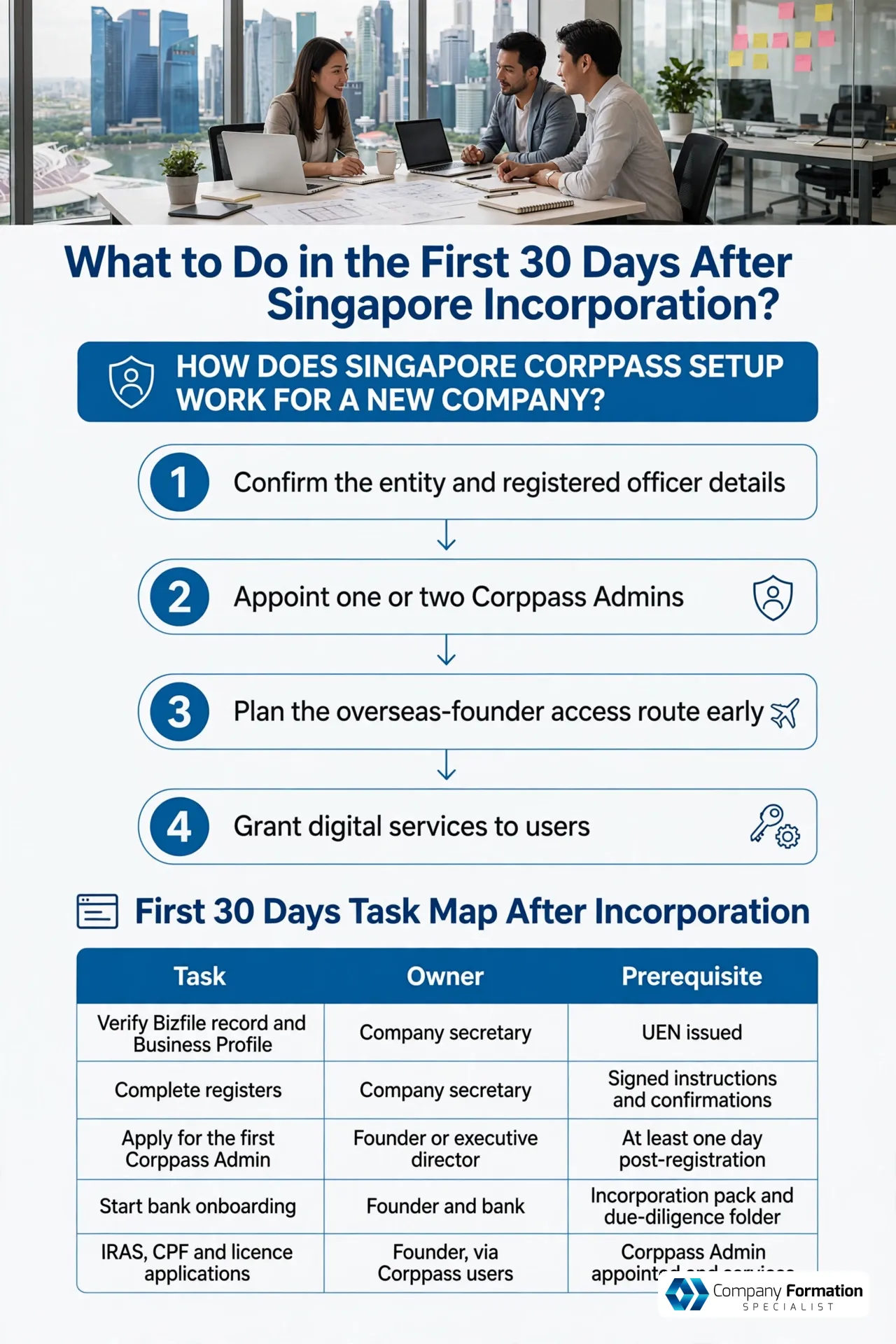
How Does Singapore Corppass Setup Work for a New Company?
Corporate online government transactions use Corppass authorisation. A newly registered entity should wait at least one day before applying for its first Corppass Admin.
Corppass acts as the company's digital identity for government services, and two official rules shape the timing. First, a newly registered entity should wait at least one day after registration before applying, and the registered officer's information must be current in ACRA first. Second, registered officers appoint Corppass Admins, and an entity must maintain at least one but no more than two.
Who should be the Admin? A governance recommendation — judgement rather than a Corppass rule — is an executive founder-director or a trusted Singapore-based employee. That person controls who can transact for the company. Appointing a nominee director purely for convenience, or handing service-provider staff broad access to tax and employment services, concentrates access in the wrong hands.
1. Confirm the entity and registered officer details
Wait at least one day after registration, then check the registered officer's particulars in the ACRA record before applying for the first Admin.
2. Appoint one or two Corppass Admins
The registered officer appoints the Admins. Choose someone who should genuinely control the company's digital access to government services.
3. Plan the overseas-founder access route early
A passport alone does not give an overseas founder instant Singpass or Corppass access. Map the foreign-user route and identity-verification steps immediately, and give one named person ownership of the setup.
4. Grant digital services to users
Once the Admin is live, authorise users for IRAS, CPF and licence services. An appointed registered filing agent can perform authorised ACRA filings through its own business-user access.
Tasks That Wait for Corppass Access
| Task | Waits for Corppass? | Real prerequisite |
|---|---|---|
| IRAS myTax Portal authorisations | Yes | Corppass Admin grants access to the relevant user |
| CPF employer transactions | Yes, once employing | Corppass access to the CPF e-service, then a CPF Submission Number |
| Customs Account activation | Confirm the current route | UEN and an eligible key person recorded with ACRA |
| Bank account application | No | Incorporation pack and beneficial-owner due-diligence folder |
| Statutory registers and resolutions | No | Signed confirmations from officers, members and controllers |
| ACRA filings | No, with a provider | A registered filing agent transacts through its own business-user access |
What Documents Do You Need to Open a Singapore Company Bank Account?
Bank onboarding can start while Corppass is being arranged, because it depends on corporate and beneficial-owner documents rather than government digital access.
Treat the bank application and the statutory workstream as parallel. As a practical recommendation, do not wait for Corppass before approaching a bank. No bank is obliged to accept any particular document set.
Each bank sets its own requirements, so check the chosen bank's current document list before applying. As a starting point, keep one consistent due-diligence folder that can be shared with any bank. Banks may request any of the items below, and requirements differ by bank and by applicant profile.
1. Company documents
Keep the current ACRA Business Profile, the constitution and a board resolution approving the account and its signatories. The resolution should match the bank's exact signatory mandate.
2. Identity and address evidence
Banks may request passports and recent proof of residential address for directors, signatories and beneficial owners. Collect this evidence early, as the chosen bank may request it.
3. Ownership and source-of-funds information
Prepare an ownership chart through to the ultimate beneficial owners, plus source-of-funds or source-of-wealth material where the bank asks for it.
4. Business evidence
Commercial support such as contracts, invoices, website material, a business plan or an expected-transaction profile helps the bank understand the company's model.
First 30 Days Task Map After Incorporation
| Task | Owner | Prerequisite | Suggested window |
|---|---|---|---|
| Verify Bizfile record and Business Profile | Company secretary | UEN issued | Day 0 |
| Complete registers, resolutions and share certificates | Company secretary | Signed instructions and confirmations | Days 0–5 |
| Apply for the first Corppass Admin | Founder or executive director | At least one day post-registration; officer details current | Days 1–5 |
| Start bank onboarding | Founder and bank | Incorporation pack and due-diligence folder | Days 2–10 |
| IRAS, CPF and licence applications | Founder, via Corppass users | Corppass Admin appointed and services granted | Days 5–20 |
| Close gaps and diary future deadlines | Secretary and founder jointly | Outstanding confirmations returned | Days 20–30 |
When Do GST, CPF, Customs and Licence Obligations Begin?
Incorporation itself does not switch these obligations on — each is triggered by what the business actually does, so the first 30 days are for identifying which apply.
None of these obligations starts automatically when the UEN is issued. The pattern an experienced practitioner looks for is simple: identify the activity first, then the regulator, then the registration it triggers.
The tax, employment and trading points below are official requirements. The overall framing — assess early, register only when triggered — is practical guidance, not a compliance deadline.
1. GST registration
The Inland Revenue Authority of Singapore (IRAS) makes registration compulsory once taxable turnover exceeds S$1 million under the retrospective or prospective tests. Reverse-charge and overseas-vendor rules can also matter, so assess your facts or take tax advice rather than relying on turnover alone.
2. CPF when you hire
Once the company becomes an employer with Central Provident Fund (CPF) obligations, it needs Corppass access to the CPF e-service before applying for a CPF Submission Number. A company with no employees does not need this yet.
3. Customs Account for traders
A business intending to import, export or use a declaring agent for TradeNet permits needs its UEN and an activated Customs Account. A key person recorded with ACRA may activate it; confirm the current route with Singapore Customs.
4. Sector licences
Incorporation does not decide whether an activity needs a licence. Establishing a hair salon business in Singapore involves different approvals from establishing an elder care services business in Singapore. The same goes for establishing a pet grooming and boarding business in Singapore, a food outlet or a trading company. Identify the activity, the regulator and any specialist advice before launch.
Which Compliance Dates Should You Diary Now?
Put three deadlines in the calendar immediately:
- Secretary appointment within six months of incorporation
- Auditor appointment within three months unless exempt
- Estimated Chargeable Income within three months after the financial year end
Most of these dates land after the first month, but they should be calendared now while the incorporation details are fresh.
The Estimated Chargeable Income (ECI) declaration is generally due within three months after the company's financial year end, unless the company qualifies for the ECI filing waiver. The waiver currently requires annual revenue of S$5 million or below. It also requires nil ECI for the relevant Year of Assessment. Do not assume it applies to your company.
Also diary the annual general meeting and annual return cycle based on your financial year end. ACRA's current fee schedule lists the annual return filing fee at S$60, and fees can change, so confirm against the published schedule before filing. If you would like a hand building this calendar, you can contact us to discuss a first-year compliance timeline.
Key Compliance Dates After the First Month
| Obligation | Deadline | Notes |
|---|---|---|
| Appoint a company secretary | Within six months of incorporation | Only if none was appointed at incorporation |
| Appoint an auditor | Within three months after incorporation | Unless the company is exempt from audit requirements |
| File Estimated Chargeable Income | Within three months after the financial year end | Waiver possible if revenue is S$5 million or below and ECI is nil |
| File the annual return | Set by your financial year end cycle | Current ACRA filing fee is S$60; confirm the published schedule |
Conclusion
After a UEN is issued, assign a named owner to each post-incorporation task. Verify the ACRA record and statutory registers first. Arrange Corppass and bank onboarding in parallel. Diary the secretary, auditor, ECI and annual-return dates.
A practical planning point is that progress can stop when an overseas founder, beneficial owner or registered officer has not completed their part. The obstacle is often an outstanding confirmation or decision rather than difficult paperwork.
Company Formation Specialist can discuss a first-month plan for your company. Get in touch to map the work that applies to your intended activity.
Turn Your UEN Into a Working Company
Our team can guide the registers, Corppass setup and first-month compliance calendar while you focus on building the business.
Frequently Asked Questions
Verify the ACRA Bizfile record against your signed incorporation instructions, download the Business Profile, and set up the statutory registers — the register of registrable controllers is due on the day of registration unless exempt. Then run Corppass setup and bank onboarding in parallel.
ACRA's current guidance requires the private register to be established on the day the company is registered, unless an exemption applies, with updates filed to the central register within two business days. The often-quoted 30-day window is out of date.
Yes, a foreign director of a local UEN company can be the Corppass Admin, but a passport alone does not give instant Singpass or Corppass access. Wait at least one day after registration, confirm the registered officer's details with ACRA, and plan the foreign-user route early with one named person owning the setup.
Bank onboarding generally depends on corporate and beneficial-owner documents, not government digital access, so it can start in parallel with Corppass setup. Each bank sets its own list, so confirm current requirements with your chosen bank.
Not automatically. IRAS makes registration compulsory once taxable turnover exceeds S$1 million under the retrospective or prospective tests, and reverse-charge or overseas-vendor rules can also apply. Assess your facts or take tax advice.

Company Formation Specialist
Author
Company Formation Specialist is a Singapore corporate services provider that guides local and foreign entrepreneurs through registering and setting up a company in Singapore.